


One of the women is Anna Vyrubova I think.

Alexandra Feodorovna with her children outside Livadia: 1913.
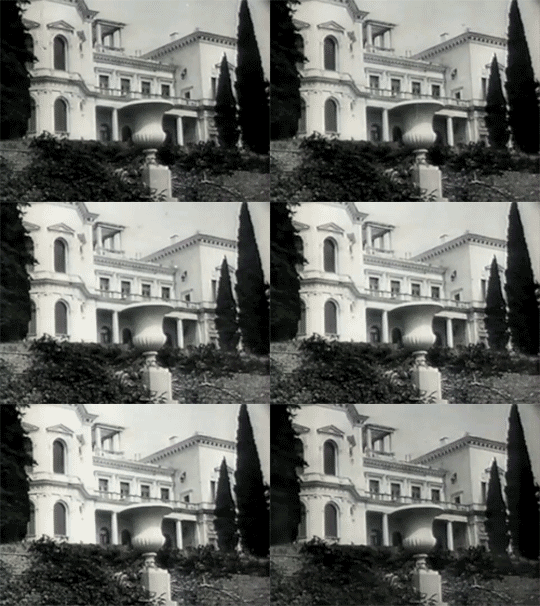
Le palais de Livadia ou de Livadie (en ukrainien : Лівадійский палац, Livadiïskyï palats ; en russe : Ливадийский дворец, Livadiski dvorets ; en tatar de Crimée : Livadiya sarayı) était le lieu de résidence estivale des derniers tsars, en particulier du dernier empereur de Russie Nicolas II et de sa famille à Livadia, en Crimée.
Le palais se trouve à 3 km de Yalta, dans la commune urbaine de Livadia, qui signifie en grec « clairière ».

Alexandra Feodorovna on the balcony at Livadia: c. 1912.

|
One of the women is Anna Vyrubova I think. |
||||
|
||||
Résidence impériale
Le petit village de Livadia ne comptait que quelques familles de Tatars de Crimée et de pêcheurs grecs, lorsqu'il fut choisi au XIXe siècle comme lieu de villégiature de certains membres de l'aristocratie russe. Le comte Potocki, d'origine polonaise, y fit construire une villa qui fut achetée par l'empereur Alexandre II et qui fit construire à sa place un grand palais, un petit palais et une église en 1861 par l'architecte italien Ippolito Monigheti (en).
Son fils Alexandre III et surtout son épouse aimaient à s'y reposer.
C'est ici que l'empereur mourut.

Salle à manger
Lorsque Nicolas II monta sur le trône, il revint plusieurs fois en famille au palais de Livadia, avec le désir de reconstruire le palais, à cause du triste souvenir de la mort de son père à laquelle il assista en 1894.

Chapelle
C'est ce qu'il fit après un séjour en Italie, en 1909, où le couple impérial s'enflamma pour le style renaissance. Aussi, pour plaire à l'impératrice Alexandra qui souhaitait un lieu retiré avec toutes les commodités modernes (téléphone, électricité, etc.), l'empereur fit appel à l'architecte Nikolaï Krasnov.

Sallle à manger
Les plans furent largement discutés en famille, comme nous l'indique
le journal intime de Nicolas II.
Il fut décidé que les quatre façades seraient toutes différentes avec des tours, dont une tour florentine.

Chambre d'Alexi
Le nouveau palais de marbre de Carrare blanc et de granite de Crimée avec son patio italien et son patio mauresque fut inauguré le 11 septembre 1911.
Il comportait 116 pièces, avec des salons et des appartements de styles différents.

Nicholas II with his sister-in-law the Grand Duchess Eleonore of Hesse
and nephew Prince George Donatus at Livadia: 1911.

Items written by and belonging to members of the Imperial family on display at Livadia.

Grand Duchesses Tatiana and Maria with Anna Vyrubova at Livadia c. 1911/12.
Nicholas II and Grand Duchess Tatiana at Livadia: 1914.

Boudoir de Tsarina Alexandra

Boudoir de Tsarina Alexandra

Grand Duchesses Maria and Anastasia with their
cousin George Donatus of Hesse at Livadia: 1912.

Tsarevich Alexei, Nicholas II and Grand Duchesses Anastasia and Olga at Livadia: 1912.

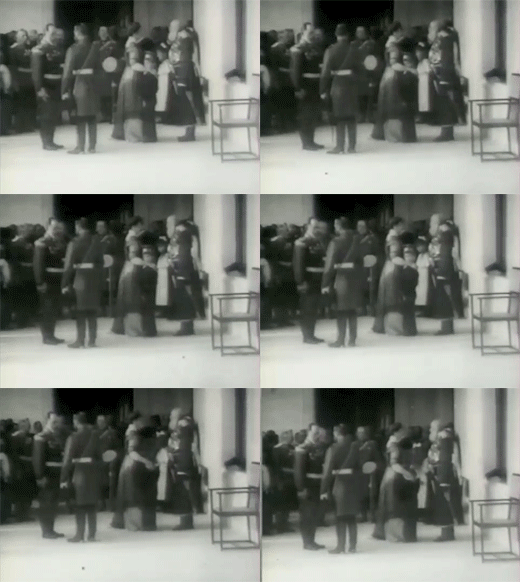
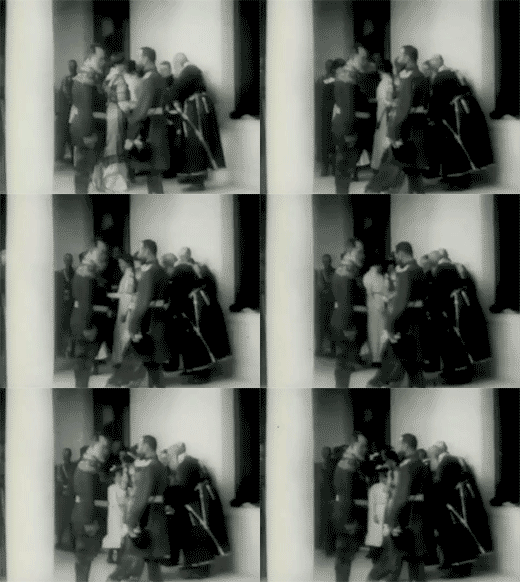
The Emperor and his daughters greeting members of the household
at Livadia as the Empress looks on: 1913.

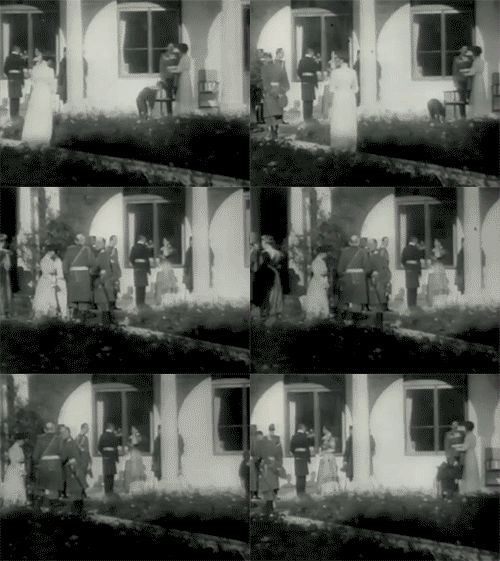
Grand Duchess Tatiana and Nicholas II visiting with some officers at Livadia: 1913.

Grand Duchesses Olga and Anastasia at Livadia: 1913.

Grand Duchess Olga and Nicholas II- Livadia:1913
The sunrise that saw us off was beautiful… We left Tsarskoe Selo at 6:10 in the morning. Thank God we are all saved and together.

Alexandra Feodorovna and Anna Vyrubova in a carriage at Livadia c. 1914.
The Romanov Family’s Alphabet - L is for Livadia.
“In St. Petersburg we work, but at Livadia, we live.” - Grand Duchess Olga Nikolaevna Romanova of Russia.
Livadia Palace (Ukrainian: Лівадійський палац, Russian: Ливадийский дворец, Crimean Tatar: Livadiya sarayı) was a summer retreat of the last Russian tsar, Nicholas II, and his family in Livadiya, Crimea in southern Ukraine.
In 1909 Nicholas and his wife travelled to Italy, where they were captivated by Renaissance palaces shown to them by Victor Emmanuel III. Upon their return, they engaged Nikolay Krasnov, Yalta’s most fashionable architect, responsible for the grand ducal residences in Koreiz, to prepare plans for a brand new imperial palace. The tsar’s diary testifies that the design was much discussed in the imperial family; it was decided that all four facades of the palace should look different. Construction works lasted for seventeen months; the new palace was inaugurated on 11 September 1911. Grand Duchess Olga Nikolaevna celebrated her 16th birthday that November at Livadia.
Is there a large version of the first Tatiana photograph? It’s so stunning :)

Here is a larger version of the picture of Tatiana above. :)

Salle de Classe des Grandes Duchesses

Bibliothèque de Tsarina Alexandra

Chambre de Tsar Nicolas II et Tsarina Alexandra
Après la révolution
Après que tout le décor intérieur, le mobilier, les archives furent pillés, détruits ou dispersés, le palais abrita une maison de repos pour les commissaires politiques et leurs familles.
La Conférence de Yalta s'y tint en 1945 ; le palais abrita les appartements de Franklin D. Roosevelt et des autres membres de la délégation américaine. La Crimée fut donnée par Khrouchtchev à l'Ukraine, en 1954, comme signe d'amitié entre la Russie soviétique et l'Ukraine soviétique.
Aujourd'hui, le palais est un musée. Cependant il est utilisé par les autorités ukrainiennes lors de sommets internationaux


WIKIPEDIA



/http%3A%2F%2Fekladata.com%2FJS5Io87fAfIYjSvJ4_JujCRz0FU%40640x534.jpg)
/http%3A%2F%2Fekladata.com%2FDrobHPdtCZ--W9QAkvsAP1h0Q9c%40460x268.jpg)
/http%3A%2F%2Fekladata.com%2Fxcy8-7fqnHZIkH-tm2lAHwa2ejs.jpg)
/http%3A%2F%2Fupload.wikimedia.org%2Fwikipedia%2Fcommons%2Fd%2Fd6%2FAlexander_II_of_Russia_photo.jpg)